
The “Perfect Sleeper” Myth: Why Waking Up at 3 AM is Normal
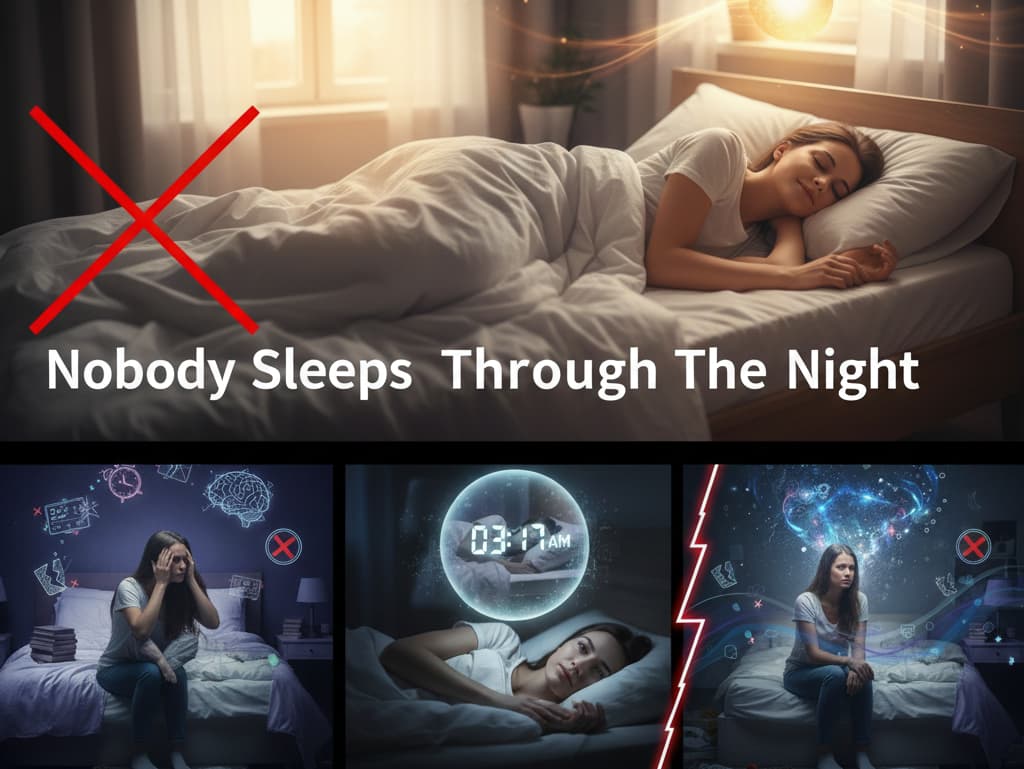
We have a Disneyfied, completely unrealistic idea of what healthy sleep looks like. We imagine putting our head on the pillow at 10 PM, blacking out instantly, and waking up exactly 8 hours later to the sound of chirping birds. So, when your eyes snap open at 3:14 AM and you realize the house is dead silent, panic sets in. You think, “I’m broken. Something is wrong with me. My tomorrow is ruined.” Let me reassure you as a sleep professional: Nobody sleeps straight through the night. Not me. Not your doctor. Not even the so-called “best sleepers” in the world. Waking up in the middle of the night isn’t a disease; it is basic human biology.
- The 90-Minute Cycle: Human sleep is not a flat line; it is a rollercoaster of 90-minute cycles. Brief awakenings between these cycles are completely natural.
- The Memory Gap: “Good sleepers” wake up just as often as insomniacs do—they just fall back asleep so fast that their brains don’t record the memory.
- The Anxiety Trap: The problem is never the awakening itself; the problem is the panic and “math anxiety” you experience when you look at the clock.
1) The Biology of the 3 AM Awakening
To stop fearing the midnight wake-up, you have to understand how your brain is wired. Sleep is not a coma. It is an active, dynamic process designed in cycles.
Every roughly 90 to 110 minutes, you transition from Light Sleep, down into Deep Sleep, up into REM (dreaming) sleep, and then… you briefly wake up. This is an evolutionary holdover. Thousands of years ago, when we slept in caves or on the savannah, it was highly beneficial for our brains to briefly surface to check the environment: “Is the fire still going? Is there a predator nearby? Am I too cold?”
Once the brain confirms you are safe, it dives right back down into the next cycle. Most people experience 3 to 5 of these “micro-awakenings” every single night. The only difference between a “good sleeper” and someone with insomnia is that the good sleeper doesn’t care. They roll over, pull up the blanket, and experience retrograde amnesia—they forget it ever happened by morning.
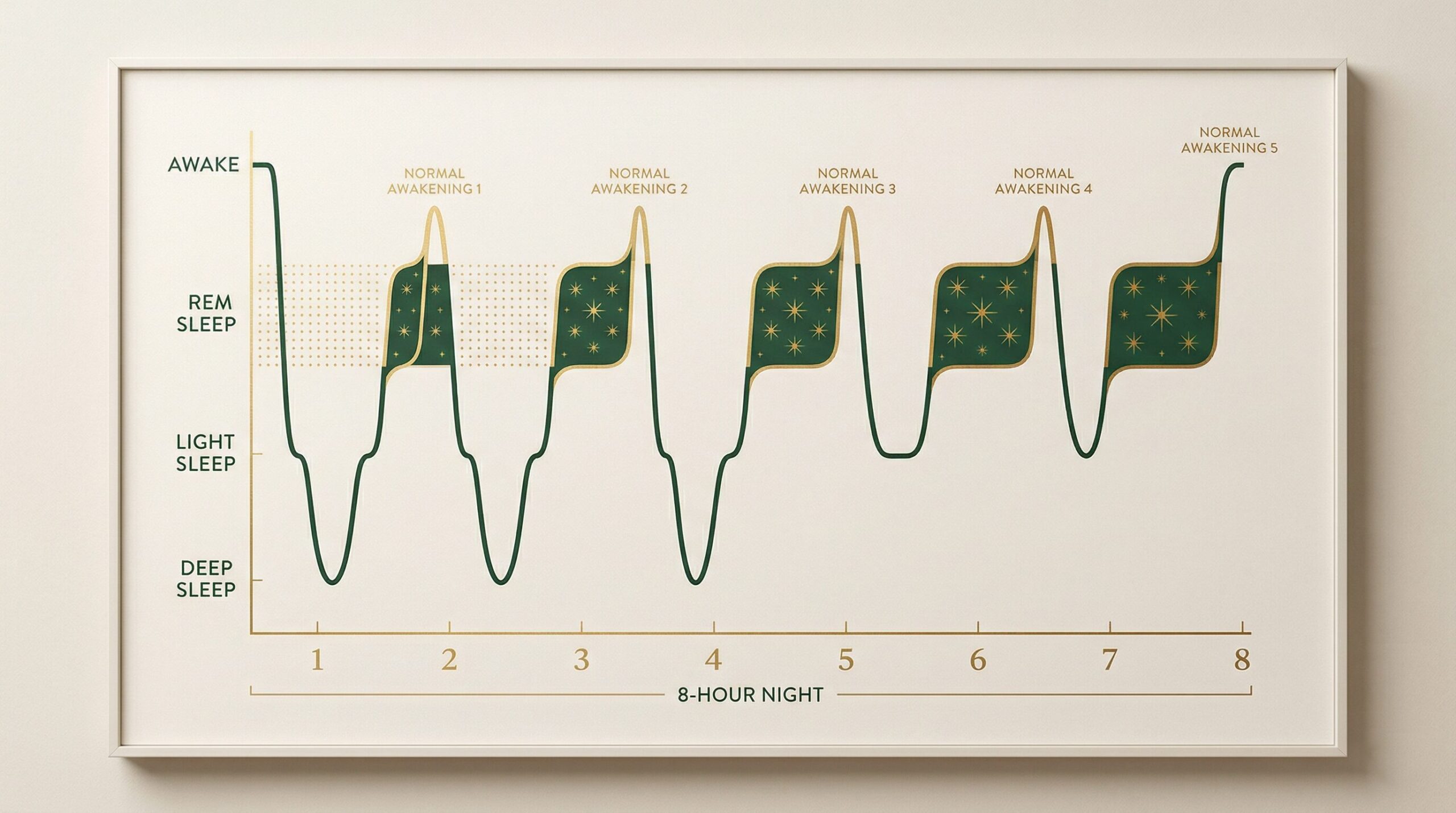
“You are not failing at sleep just because you woke up. You are simply between cycles. It is a feature, not a bug.”
2) The Historical Reality of “Second Sleep”
If you need more proof that the 8-hour unbroken block is a myth, look at history. Before the invention of the lightbulb and the industrial revolution, humans did not sleep in one continuous chunk. They practiced Biphasic Sleep.
Historian Roger Ekirch famously uncovered hundreds of historical documents detailing how humans naturally slept in two distinct shifts:
- First Sleep: From shortly after sunset until around 1:00 or 2:00 AM.
- The Watch: A completely normal 1 to 2-hour waking period in the middle of the night. People used this quiet time to read, pray, talk, or be intimate. It was considered the most peaceful part of the day.
- Second Sleep: From the end of the watch until dawn.
It was only when factories demanded we show up for a rigid 9-to-5 shift that society decided we must compress all our rest into a single, uninterrupted block. Your body hasn’t forgotten its ancient rhythm. When you wake up at 3 AM, you aren’t broken; you are just experiencing “The Watch.”
3) How to Handle the Awakening (Without Ruining Your Night)
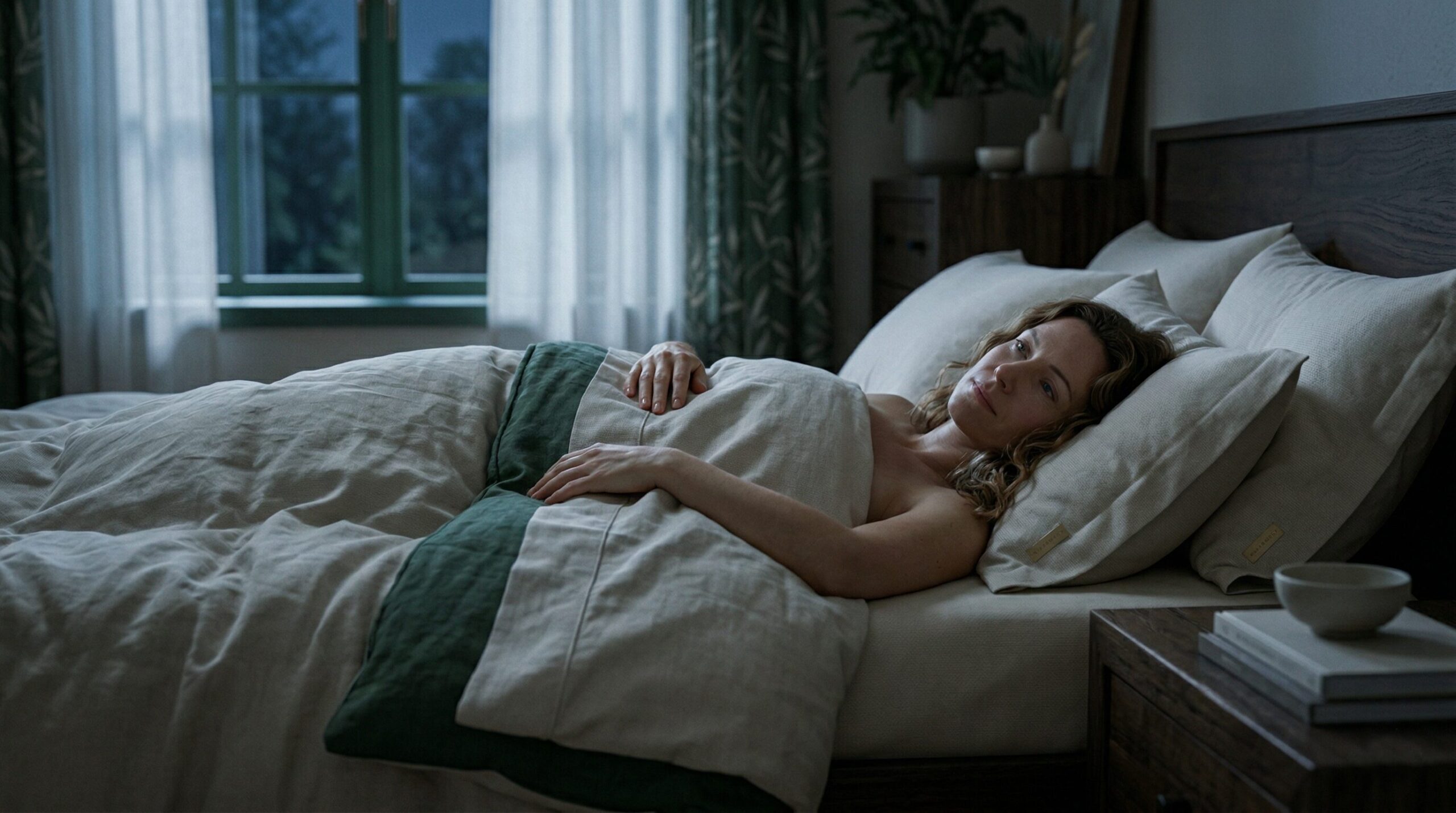
The biological awakening is harmless. It is your reaction to the awakening that causes insomnia. When you wake up and immediately feel a surge of frustration, you dump adrenaline into your bloodstream. Adrenaline is the enemy of sleep.
The Middle-of-the-Night Protocol:
- Never Do “Sleep Math”: The absolute worst thing you can do is look at the clock and calculate: “If I fall asleep right now, I can still get 3 hours.” Hide your clock. Knowing the exact time provides zero benefit and massive anxiety.
- Change the Narrative: When you wake up, consciously replace the panic thought. Instead of “Oh no, I’m awake,” tell yourself: “Oh, I just finished a sleep cycle. It feels so nice to be in this warm, safe bed with nothing to do.”
- Enjoy the Free Rest: If you find yourself awake for more than 20 minutes, stop trying to force sleep. Just enjoy the physical rest. Passive resting in the dark still provides incredible recovery for your muscles and immune system.
Embrace the wakefulness. Stop demanding perfection from your biology. The moment you stop fighting the 3 AM awakening, it loses its power over you.
4) Common Misconceptions (FAQ)
Q1: I wake up at exactly 3:15 AM every single night. Is that my liver/cortisol?
While some alternative health theories link specific wake times to organ function, the scientific reality is usually simpler: Circadian Rhythm and Sleep Cycles. If you go to bed at the same time every night, your 90-minute sleep cycles will line up predictably. You are simply waking up at the natural transition point between your second and third sleep cycle.
Q2: Should I get up and eat a snack if I wake up hungry?
Generally, no. Eating in the middle of the night kickstarts your digestive system and sends a powerful signal to your circadian clock that it is “daytime.” This can train your body to wake you up at that exact time every night just to get a snack. If you are genuinely starving, eat a little more protein with dinner, but avoid the midnight kitchen trip.
Q3: What if I have to use the bathroom every time I wake up?
This is a classic “chicken or egg” scenario. Did a full bladder wake you up, or did you wake up naturally at the end of a sleep cycle and *then* realize you could probably use the bathroom? Usually, it’s the latter. If you do go to the bathroom, keep the lights as dim as possible (use a nightlight) and avoid checking your phone on the way.
Stop fighting your natural sleep cycles. Learn to manage your middle-of-the-night anxiety.
Take the Free Sleep Assessment Join the Recovery NewsletterThe Slumbelry Commitment
Sleep is the most vulnerable state of human existence. It is where we heal, reset, and grow.
At Slumbelry, we don’t just sell sleep products; we advocate for your physiological right to rest. From ergonomic support to light management, every solution we offer is designed with one obsession: Respecting your Biology.
Science is our language, but your recovery is our purpose. You take care of everything else in your life—let us take care of your nights.
Rest Deeply,
The Slumbelry Team