
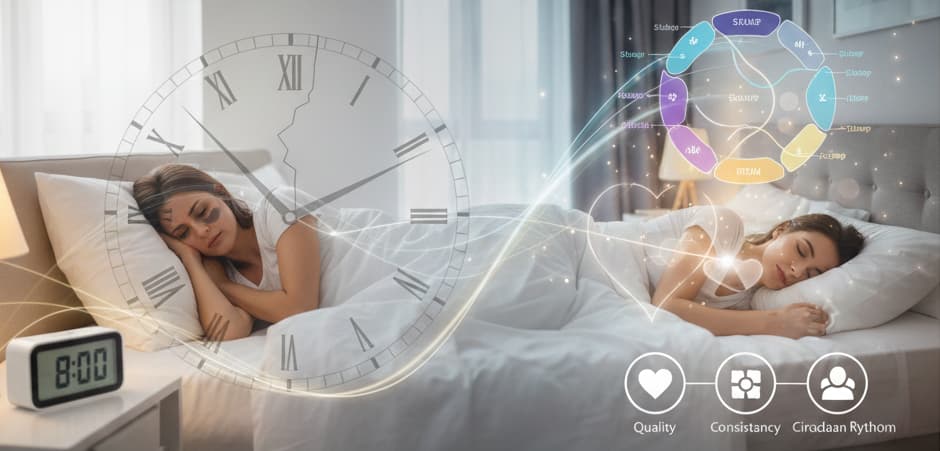
You do the math. You go to bed at 11:00 PM. You set your alarm for 7:00 AM. “Perfect,” you think. “That’s exactly 8 hours. I’m going to feel amazing.”
But when the alarm screams at 7:00 AM, you don’t feel amazing. You feel like you’ve been hit by a truck. Your eyes are heavy, your brain is foggy, and you’re hitting snooze before you’re even fully conscious. “What happened?” you ask yourself. “I got my 8 hours!”
Welcome to the 8-Hour Myth. For decades, we’ve been told that sleep is a block of time. Get 8 hours, and you’re good. But Nick Littlehales, the elite sleep coach who transformed the recovery habits of Manchester United and Cristiano Ronaldo, argues that this approach is fundamentally flawed. Your body doesn’t run on hours; it runs on cycles.
The Science: It’s Not a Block, It’s a Wave
Sleep is not a uniform state of unconsciousness. It is a dynamic journey through different stages. A typical sleep cycle lasts approximately 90 minutes. During this time, you move through: 1. Light Sleep (NREM 1 & 2): The transition phase. 2. Deep Sleep (NREM 3 & 4): Physical restoration (muscle repair, growth hormone release). 3. REM Sleep: Mental restoration (dreaming, memory consolidation).
After about 90 minutes, the cycle ends, and you briefly enter a lighter state (or even wake up for a micro-second) before starting the next cycle.
The “Crash Landing”
Here is why you feel groggy at 7:00 AM. If you wake up in the middle of a Deep Sleep phase, your brain is disoriented. It’s suffering from Sleep Inertia. Imagine a diver deep underwater. If you yank them to the surface instantly, they get “the bends.” Waking up from deep sleep is the neurological equivalent.If you wake up at the end of a 90-minute cycle, you are naturally in a lighter state. You wake up feeling refreshed, alert, and ready to go.
The Strategy: Think in 90s
Nick Littlehales’ R90 Technique suggests we stop counting hours and start counting cycles. Instead of aiming for 8 hours (which is 480 minutes—a weird number biologically), aim for multiples of 90 minutes.
- 5 Cycles: 7.5 Hours (The Standard Goal)
- 4 Cycles: 6 Hours (The Minimum for Functionality)
- 6 Cycles: 9 Hours (The Athlete/Recovery Mode)
Why 8 Hours Fails
8 hours is 5.3 cycles. That means you are setting your alarm to ring right in the middle of your 6th cycle—likely during Deep Sleep. By trying to get “more” sleep (8 hours vs 7.5), you actually make yourself feel worse.Quality Over Quantity
It’s not just about the math; it’s about the continuity. A 90-minute cycle only works if it’s uninterrupted. If you toss and turn, or if your partner wakes you up, you break the cycle and have to restart. This is where your sleep surface matters. A mattress that isolates motion and relieves pressure points ensures that once you enter a cycle, you stay in it until the end.
The Takeaway
Tonight, try a little experiment. If you need to wake up at 7:00 AM, count back in 90-minute increments.
- 7:00 AM minus 7.5 hours = 11:30 PM.

The Slumbelry Commitment
Sleep is the most vulnerable state of human existence. It is where we heal, reset, and grow.
At Slumbelry, we don’t just sell sleep products; we advocate for your physiological right to rest. From ergonomic support to light management, every solution we offer is designed with one obsession: Respecting your Biology.
Science is our language, but your recovery is our purpose. You take care of everything else in your life—let us take care of your nights.
Rest Deeply,
The Slumbelry Team