
Sleeping Pills for Insomnia: Why Sedation Isn’t Sleep
Disclaimer: I am a sleep consultant, not your doctor. Never stop prescription medication abruptly without medical supervision.
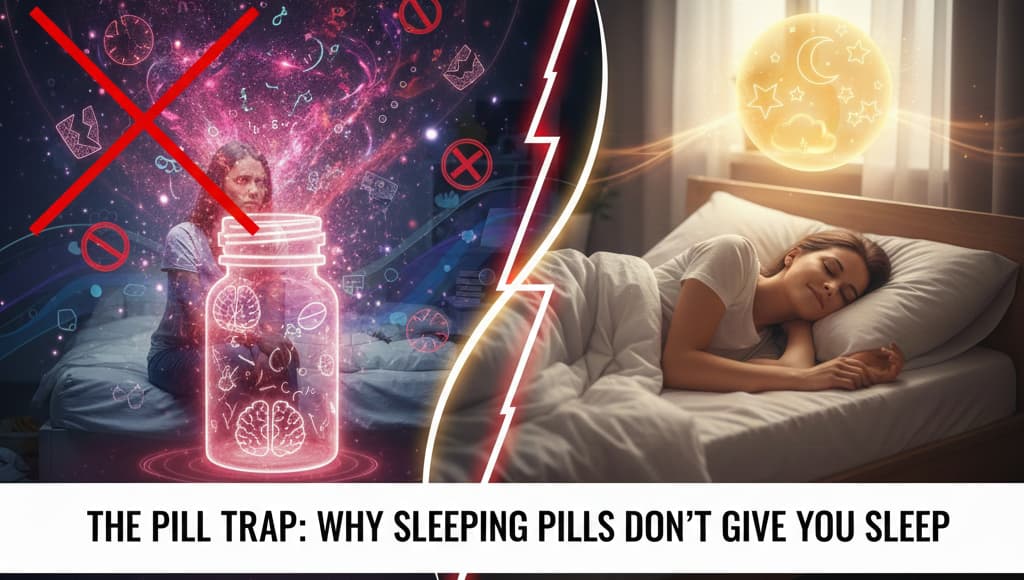
It is the most common, desperate plea I hear in my practice: “I haven’t slept in weeks. I just need something strong to knock me out.” We treat chronic insomnia the same way we treat a headache. Take a pill, the pain vanishes. But taking sleeping pills for insomnia does not magically create sleep. The harsh, counter-intuitive truth the pharmaceutical industry rarely advertises is this: sedation is not sleep. You are buying unconsciousness, but you are sacrificing the restorative architecture your brain needs, ultimately setting yourself up for severe rebound insomnia when you try to stop.
- Prescription sleeping pills and Z-drugs act as sedative-hypnotics; they knock out the cerebral cortex but destroy the natural architecture of Deep Sleep and REM sleep.
- Many patients experience “anterograde amnesia”—they still wake up multiple times at night, but the drug prevents their brain from remembering the awakenings.
- Quitting pills cold turkey triggers “Rebound Insomnia,” a vicious withdrawal cycle that convinces you that you are physically incapable of sleeping without medication.
1) The Science Behind It: Sedation vs. Sleep Architecture
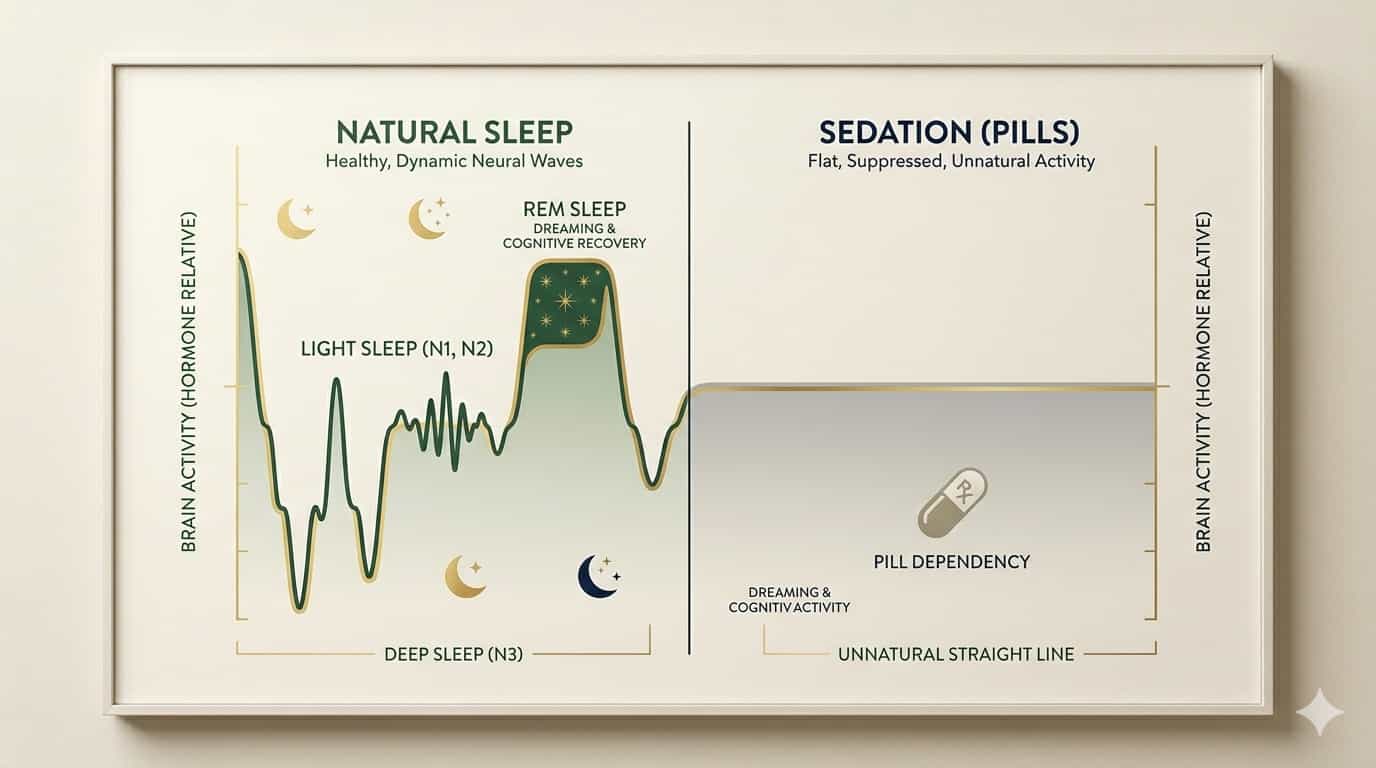
Natural sleep is not a passive “off” switch. It is a highly active, complex dance of brain waves. Throughout a healthy night, your brain cycles through light sleep, slow-wave deep sleep (where physical repair, immune strengthening, and cellular detox happen), and REM sleep (where emotional processing and memory consolidation occur). This precise architecture is non-negotiable for human health.
Most common prescription sleep aids—specifically Benzodiazepines and Z-drugs (like Ambien or Zopiclone)—belong to a class of drugs called sedative-hypnotics. They work by targeting the GABA receptors in your brain, essentially flooding your central nervous system with an inhibitory neurotransmitter that shuts down neuronal firing.
They do not induce natural sleep cycles. They induce a synthetic state that is neurologically closer to mild anesthesia or a light coma than actual sleep. You are unconscious, yes. But your brain is not performing the vital maintenance work it requires.
2) The Missing REM and The Zombie Effect
If you have ever taken a strong sleeping pill, slept for a full nine hours, but still woke up feeling like you were hit by a truck, you have experienced the destruction of your sleep architecture firsthand.
Sedative-hypnotics are notorious for suppressing both Slow-Wave Deep Sleep and Rapid Eye Movement (REM) sleep. Here is what that actually does to your body:
- When Deep Sleep is Blocked: Your pituitary gland fails to release the necessary surge of Human Growth Hormone (HGH). Micro-tears in your muscles aren’t repaired. Your immune system isn’t fortified. You wake up feeling physically heavy, aching, and unrefreshed.
- When REM Sleep is Blocked: Your brain’s amygdala (the emotion center) doesn’t get to properly process the stress of the previous day. You wake up feeling emotionally fragile, highly irritable, anxious, and suffering from severe brain fog.
“You can spend 9 hours unconscious on a sedative, but if you strip away the REM and Deep Sleep, you are starving your brain of recovery. You get the quantity of time in bed, but absolutely zero quality.”
3) The Amnesia Illusion: Did You Actually Sleep?
Here is perhaps the most unsettling mechanism behind how some of these drugs appear to “work.” Often, the pill doesn’t actually significantly increase the total amount of time you spend asleep. Instead, it triggers a side effect called anterograde amnesia.
Under the influence of the drug, you might still wake up four or five times in the middle of the night. You might toss, turn, and stare at the ceiling. However, the chemical prevents your hippocampus from forming new short-term memories. When your alarm goes off the next morning, you look at the clock and think you slept solidly through the night, simply because your brain deleted the memories of the awakenings.
4) The Vicious Cycle of Rebound Insomnia
The true trap of the sleeping pill snaps shut not when you take it, but when you try to stop. The human brain is incredibly adaptive. When you flood it with synthetic GABA to force sedation every night, it responds by down-regulating its own natural GABA receptors. It essentially thinks, “Well, if you are going to provide the chemical from the outside, I don’t need to produce it internally anymore.”
When you decide to stop taking the pill, your brain goes into sudden, severe withdrawal. Your nervous system, now lacking its natural inhibitory brakes, shifts into massive overdrive. This triggers Rebound Insomnia.
For a period of days or even weeks after stopping the medication, your sleep will be significantly worse, more fractured, and more anxiety-inducing than it was before you ever touched the pill. In a state of sheer panic and exhaustion, most people logically conclude, “See? I am completely broken. I physically cannot sleep without my medication.” They refill the prescription, and the psychological dependence is cemented. You are hooked.
5) Actionable Protocol: The Exit Strategy
If you want to escape the pill trap, you have to stop treating the symptom (wakefulness) and start treating the root cause (hyperarousal and broken sleep associations).
The Tapering Protocol:
- Consult Your Doctor: Never quit prescription sleep aids cold turkey. This can cause severe withdrawal, including seizures in extreme cases.
- The Gradual Taper: Work with your physician to reduce your dosage by 25% every 1 to 2 weeks. This gives your brain’s natural GABA receptors time to slowly up-regulate and come back online.
- Expect the Rebound: Mentally prepare for the fact that your sleep will get worse before it gets better. Accept the Rebound Insomnia as a temporary biological healing process, not a permanent failure.
- Implement CBT-I: As you taper off, begin Cognitive Behavioral Therapy for Insomnia (CBT-I). Use Sleep Restriction and Stimulus Control to naturally build a massive sleep drive that will override the withdrawal.

6) Frequently Asked Questions (FAQ)
Q1: Are over-the-counter (OTC) sleep aids like Benadryl or ZzzQuil safer?
Most OTC sleep aids rely on antihistamines (like diphenhydramine). While they aren’t as physically addictive as Z-drugs, they cause severe next-day grogginess and build tolerance incredibly quickly—often within three days. Long-term use of antihistamines is also being studied for potential links to cognitive decline.
Q2: Does Melatonin count as a sleeping pill?
Melatonin is a hormone, not a sedative. It does not “knock you out.” It simply signals to your brain that it is nighttime. While safer than sedatives, most people take drastically incorrect doses (10mg instead of the optimal 0.3mg-1mg) at the wrong time, which actually disrupts their circadian rhythm further.
Q3: How long does Rebound Insomnia last?
Depending on how long you were on the medication and how quickly you tapered off, the acute phase of rebound insomnia typically lasts anywhere from 3 to 14 days. Knowing that this is a normal, temporary biological withdrawal symptom—and not a permanent failure of your brain—is crucial for getting through it.
Q4: Can I use CBD or Magnesium instead of prescription pills?
Yes. Magnesium Glycinate and high-quality CBD act as natural relaxants that gently support the nervous system without forcing sedation or destroying your sleep architecture. They are excellent supplements to use while tapering off harsher medications.
Q5: Are sleeping pills ever medically necessary?
Yes. In cases of acute, severe trauma—a sudden death in the family, a violent crisis, or a massive localized stressor—a short-term prescription (2 to 4 days) can prevent a total psychological breakdown. However, they are not a viable long-term solution for chronic insomnia.
Stop masking the problem. Start rebuilding your natural sleep drive.
Take the Free Sleep Assessment Join the Recovery NewsletterThe Slumbelry Commitment
Sleep is the most vulnerable state of human existence. It is where we heal, reset, and grow.
At Slumbelry, we don’t just sell sleep products; we advocate for your physiological right to rest. From ergonomic support to light management, every solution we offer is designed with one obsession: Respecting your Biology.
Science is our language, but your recovery is our purpose. You take care of everything else in your life—let us take care of your nights.
Rest Deeply,
The Slumbelry Team
Slumbelry™ Sleep System – Science-Backed. Chronotype-Optimized. Author: Slumbelry Research Team.