
×
Slumbelry
HOME SHOP WELLBEING BLOG LOGIN / REGISTER SEARCH CONTACT

Orthosomnia: When Tracking Your Sleep Destroys It

Article Image

Written by Dr. Lycan Dizon, Slumbelry Chief Sleep Consultant

We live in the age of quantification. We count our steps, track our calories, and map our heart rates. Naturally, we started tracking our sleep.

It started with good intentions. “If I can measure it, I can improve it,” we thought. We strapped on Apple Watches, Oura Rings, and Whoop bands. We woke up every morning and immediately checked our “Sleep Score.”

  • 85? Good job.
  • 62? Oh no. I must be exhausted.

But for many, this data has backfired. Sleep specialists have coined a new term for this condition: Orthosomnia. It comes from “ortho” (correct) and “somnia” (sleep)—the perfectionist quest for “correct” sleep that ironically keeps you awake.

The Nocebo Effect of Data

Here is a common scenario: You wake up feeling pretty good. You stretch, ready for the day. Then you check your app. It says: “Sleep Score: 55. Readiness: Low.”

Suddenly, you feel tired. You start looking for signs of fatigue. “Maybe my eyes are heavy. Maybe I shouldn’t work out today.”

This is the Nocebo Effect—the negative twin of the Placebo Effect. Because the device told you that you slept poorly, your brain manifests the symptoms of poor sleep, even if your biological rest was adequate.

The Accuracy Problem

We place blind faith in these devices, but they are not medical-grade EEGs. They cannot measure brain waves. They estimate sleep stages based on movement and heart rate.

If you lie perfectly still while reading a book, your tracker might think you are in “Light Sleep.” If you toss and turn during a dream, it might think you are awake. Studies have shown commercial trackers can be off by significant margins, especially when distinguishing between Light and REM sleep.

You might be agonizing over a “lack of Deep Sleep” that isn’t even real.

Are You Suffering from Orthosomnia?

Ask yourself these questions: 1. Is the first thing you do in the morning checking your sleep score? 2. Do you feel anxious before bed, wondering if you will get a “good number”? 3. Does a low score ruin your mood, even if you physically feel fine? 4. Have you stayed in bed longer than necessary just to “boost your stats”?

If you answered yes, your tracker has become a stressor, not a tool.

How to Detach from the Data

I am not saying you must throw your expensive gadget in the trash. But you need to change your relationship with it.

1. The “Feel First” Rule

When you wake up, do not check your phone or watch immediately. Spend the first 30 minutes assessing how you feel. Are you groggy? Alert? Happy? Establish your own internal baseline before you let an algorithm tell you how you feel.

2. Hide the Score

Some apps allow you to hide the daily score or view only weekly trends. Sleep is variable; one bad night means nothing. Trends over months matter; a random Tuesday score of 64 does not.

3. The Weekend Detox

Take the tracker off on Friday night and put it back on Monday morning. Relearn what it feels like to sleep without being watched. You might find that the freedom from judgment allows you to relax deeper than any algorithm could measure.

Sleep is a biological instinct, not a high score to be beaten. Your body knows how to rest. Sometimes, the best way to help it is to stop measuring it.

The Slumbelry Commitment

Sleep is the most vulnerable state of human existence. It is where we heal, reset, and grow.

At Slumbelry, we don’t just sell sleep products; we advocate for your physiological right to rest. From ergonomic support to light management, every solution we offer is designed with one obsession: Respecting your Biology.

Science is our language, but your recovery is our purpose. You take care of everything else in your life—let us take care of your nights.

Rest Deeply,
The Slumbelry Team
The Snooze Button Lie: Why Those “9 More Minutes” Are Ruining Your Morning

Article Image

Written by Dr. Lycan Dizon, Slumbelry Chief Sleep Consultant

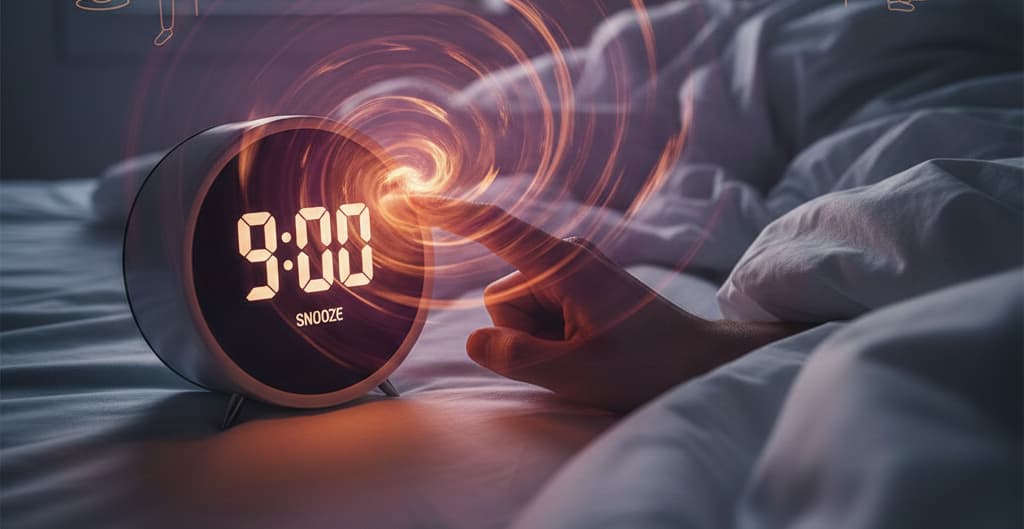
It is the most seductive button in the world. The alarm goes off, pulling you out of a warm dream. The room is cold. The day ahead looks exhausting. You see the option: Snooze. 9 minutes.

You tell yourself, “I just need a few more minutes to finish this sleep. Then I’ll be ready.”

It is a lie. That button is not your friend. It is a mechanism for self-sabotage that virtually guarantees you will feel terrible for the next four hours.

The Biology of Waking Up

To understand why, we need to look at sleep cycles. A full sleep cycle (Light -> Deep -> REM) takes about 90 minutes. When your alarm goes off the first time, ideally, you are near the end of a cycle. Your body has likely already started preparing to wake up by raising your core temperature and releasing cortisol.

When you hit snooze and drift back off, you don’t go into “light” rest. Because you are sleep-deprived (like most of us), your brain often plunges you straight back into the beginning of a new sleep cycle.

Sleep Inertia: The Fog of War

Then, 9 minutes later, the alarm screams again.

This time, you are shocking your brain awake right in the middle of a new cycle. This is called Sleep Inertia.

Imagine a car engine cruising at 60mph on the highway (Deep Sleep). The alarm slams the brakes instantly. The engine shudders, smokes, and stalls. That is your brain on snooze.

Sleep inertia is that heavy, groggy, “zombie” feeling. It affects your decision-making, reaction time, and mood. Typically, natural sleep inertia lasts 15-30 minutes. But when you repeatedly hit snooze—fragmenting your sleep into 9-minute shreds—you can extend this state of grogginess for up to 4 hours.

You are essentially starting your day with a cognitive handicap.

Why 9 Minutes?

A bit of trivia: The 9-minute snooze is a relic of mechanical engineering. In the 1950s, clockmakers had to fit the snooze gear into existing mechanisms. 10 minutes was physically impossible due to the gear teeth alignment, so they settled on 9-ish minutes. It has no biological basis whatsoever.

How to Break the Addiction

Breaking the snooze habit is simple, but not easy. It requires re-training your brain.

1. The “Across the Room” Method

Move your phone or alarm clock to the other side of the room. You must physically get out of bed to turn it off. Once your feet are on the floor, the hardest part is over. Do not get back in.

2. Use Light, Not Sound

Our bodies are evolved to wake up with the sun, not a digital siren. Use a sunrise simulation alarm clock or leave your curtains slightly open. Light suppresses melatonin and naturally pulls you out of sleep, often before the sound alarm even goes off.

3. The “No Negotiation” Rule

Decide the night before: “I wake up at 7:00 AM.” Treat it as a contract. When the alarm rings, you do not negotiate with yourself. You count “3-2-1” and stand up.

If you truly need more sleep, set your alarm for 7:30 AM and sleep solidly until then. 30 minutes of unbroken sleep is restorative. 30 minutes of snoozed, fragmented sleep is torture. Stop micro-dosing your rest and get the real thing.

The Slumbelry Commitment

Sleep is the most vulnerable state of human existence. It is where we heal, reset, and grow.

At Slumbelry, we don’t just sell sleep products; we advocate for your physiological right to rest. From ergonomic support to light management, every solution we offer is designed with one obsession: Respecting your Biology.

Science is our language, but your recovery is our purpose. You take care of everything else in your life—let us take care of your nights.

Rest Deeply,
The Slumbelry Team
The Racing Mind: How to Hit the “Off” Switch When Your Brain Won’t Shut Up

Article Image

Written by Dr. Lycan Dizon, Slumbelry Chief Sleep Consultant

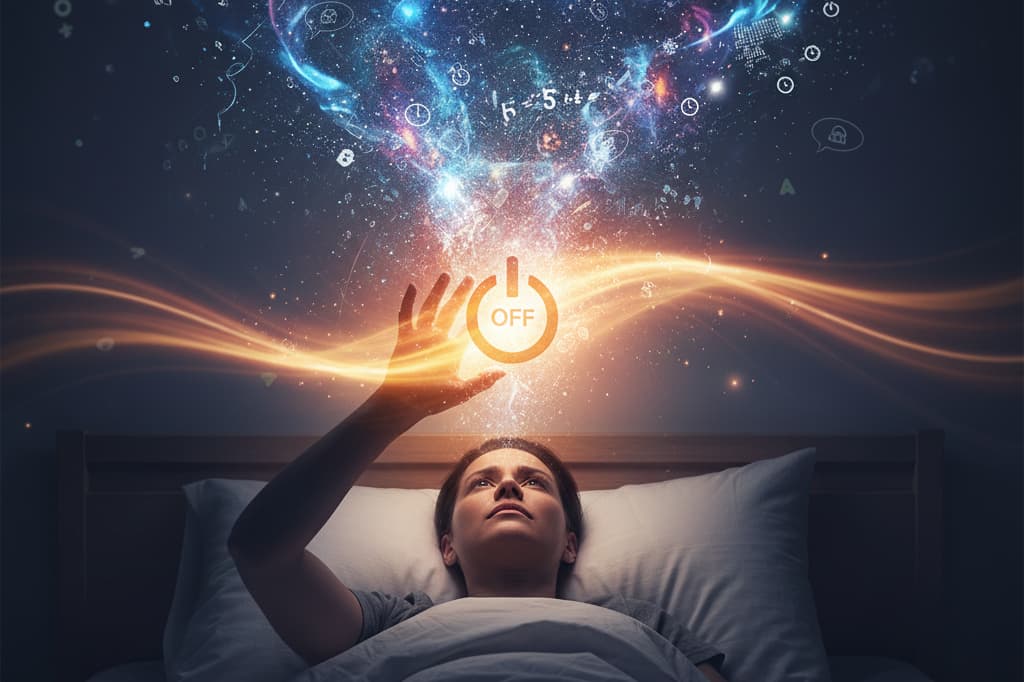
It’s 11:30 PM. Your body is exhausted. Your eyelids feel heavy. You climb into bed, desperate for rest. And then, the moment your head hits the pillow—click.

The lights go on in the factory of your mind.

Suddenly, you’re remembering an awkward email you sent in 2018. You’re rehearsing tomorrow’s presentation. You’re worrying about the global economy, your retirement fund, and whether you locked the back door.

This is the “Tired but Wired” phenomenon, clinically known as cognitive hyperarousal. And for many high-functioning professionals, it is the primary barrier to deep sleep.

The Neurology of the Racing Mind

Why does this happen? During the day, your brain is bombarded with stimuli—notifications, conversations, decisions. It is in “acquisition mode.” When you finally lie down in the quiet dark, the external noise stops, and your brain switches to “processing mode.”

Without distractions, your default mode network (DMN) takes over. This is the part of the brain responsible for self-reflection, planning, and worrying. Essentially, your brain thinks this quiet time is a conference room meeting it scheduled with you to review your anxieties.

The Solution: Do Not “Try” to Sleep

The worst thing you can do is try to force your brain to stop. Trying to sleep is an active process; sleep is a passive release. The more you fight the thoughts, the more cortisol (stress hormone) you release, pushing sleep further away.

Instead, we need to distract the brain with something boring enough to induce sleep, but engaging enough to block the worries.

1. The “Brain Dump” Protocol

Two hours before bed—not right before—take a physical notebook. Write down everything that is worrying you. Next to each item, write the very next step you can take to solve it.

  • Worry: “I haven’t finished the Q3 report.”
  • Action: “I will spend 30 minutes on the outline tomorrow at 9:00 AM.”

Once it is on paper, your brain feels permission to let it go. You have “outsourced” the worry to the notebook.

2. Cognitive Shuffling (The “Random Word” Game)

This technique, developed by cognitive scientist Dr. Luc Beaudoin, creates a “scramble” in your brain that mimics the onset of sleep.

  • Pick a neutral word, like “BEDTIME.”
  • For each letter, visualize a series of unrelated words.
  • B: Bear, Ball, Bus, Banana. Visualize each one for a few seconds.
  • E: Elephant, Egg, Ear.
  • D: Dog, Door, Drum.

By forcing your brain to jump between unrelated images, you disrupt the linear narrative of your worries (the “racing” track). This mimics the fragmented, dream-like imagery that occurs naturally as we drift off, signaling to your brain that it’s safe to sleep.

The 4-7-8 Breaker

If the mental noise is too loud, engage the body. Use the 4-7-8 breathing technique: 1. Inhale quietly through the nose for 4 seconds. 2. Hold the breath for 7 seconds. 3. Exhale forcefully through the mouth for 8 seconds (making a whoosh sound).

This forces your nervous system to shift from Sympathetic (fight or flight) to Parasympathetic (rest and digest). You physically cannot be in a panic state while breathing this slowly.

Your mind is a tool, not the master. You wouldn’t leave your laptop running high-intensity software all night; don’t let your brain do it either. Give it a shutdown procedure, and reclaim your nights.

The Slumbelry Commitment

Sleep is the most vulnerable state of human existence. It is where we heal, reset, and grow.

At Slumbelry, we don’t just sell sleep products; we advocate for your physiological right to rest. From ergonomic support to light management, every solution we offer is designed with one obsession: Respecting your Biology.

Science is our language, but your recovery is our purpose. You take care of everything else in your life—let us take care of your nights.

Rest Deeply,
The Slumbelry Team
Caffeine: The Invisible Thief in Your Mug

Article Image

Written by Dr. Lycan Dizon, Slumbelry Chief Sleep Consultant

“I can drink a double espresso at 9 PM and fall asleep like a baby.”

If I had a dollar for every time a patient told me this, I’d be retired on a private island.

Here is the uncomfortable truth I tell them: You aren’t asleep. You are sedated.

There is a massive difference. And that difference is why you wake up tired, reach for another coffee, and continue the cycle.

The Mechanism: Blocking the “Sleep Hunger”

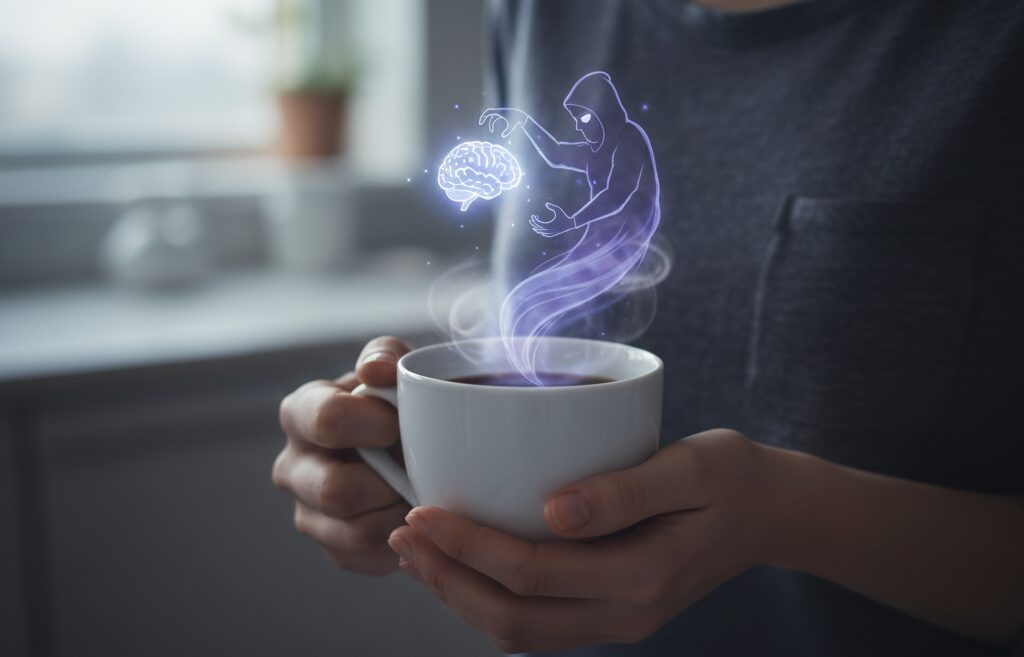
To understand caffeine, you must understand Adenosine. Think of Adenosine as “Sleep Hunger.” From the moment you wake up, it builds up in your brain. The more it builds, the sleepier you get.

Caffeine is a master of disguise. It looks exactly like Adenosine to your brain receptors. It swoops in, blocks the receptors, and tells your brain: “Hey, we aren’t tired at all!”

But the Adenosine doesn’t go away. It keeps building up behind the dam. When the caffeine wears off (the crash), that dam breaks, and you are hit with a tsunami of fatigue.

The “Half-Life” Problem

This is the killer. Caffeine has a half-life of about 5-7 hours. * The Math: If you have a coffee (200mg caffeine) at 4 PM… * At 10 PM, you still have 100mg active in your system. * That’s equal to chugging a Red Bull right before bed.

You might “fall asleep” (lose consciousness), but your brain cannot enter Deep Sleep (SWS) efficiently. * Result: You get “fragile” sleep. You wake up unrefreshed. The Trap: You feel groggy, so you drink more* coffee earlier in the day.

The “Chocolate Myth”

I often have to defend chocolate. Patients ask if they should ban dessert. Let’s look at the data from How To Sleep Well: * Milk Chocolate (1 oz): ~6mg caffeine. * Dark Chocolate (1 oz): ~20mg caffeine. * Coffee (8 oz): ~95-200mg caffeine.

As the text says: “Many killjoy ‘experts’ caution that chocolate contains caffeine… However, the levels are really quite low.” You would need to eat a mountain of milk chocolate to get a caffeine buzz. Don’t stress about the square of chocolate; stress about the 4 PM latte.

The Clinical Detox Protocol

I don’t hate coffee. I love it. But you must use it as a tool, not a crutch.

1. The Curfew: No caffeine after 2 PM. Period. Give your liver time to clear it before bed. 2. The Wait: Don’t drink coffee in the first 90 minutes of waking. Let your cortisol clear the morning grogginess naturally first. 3. The Swap: If you crave a warm drink at night, don’t just switch to Decaf (which still has some caffeine). Switch to a ritual. * Ritual: Put on your Slumbelry Light Management glasses. Brew a herbal tea (Chamomile or Valerian). Signal to your body that the day is done.

The Slumbelry Commitment

Sleep is the most vulnerable state of human existence. It is where we heal, reset, and grow.

At Slumbelry, we don’t just sell sleep products; we advocate for your physiological right to rest. From ergonomic support to light management, every solution we offer is designed with one obsession: Respecting your Biology.

Science is our language, but your recovery is our purpose. You take care of everything else in your life—let us take care of your nights.

Rest Deeply,
The Slumbelry Team

The Gender Sleep Gap: Why Women Need Different Sleep Strategies

Article Image

Written by Dr. Lycan Dizon, Slumbelry Chief Sleep Consultant

The Clinical Perspective

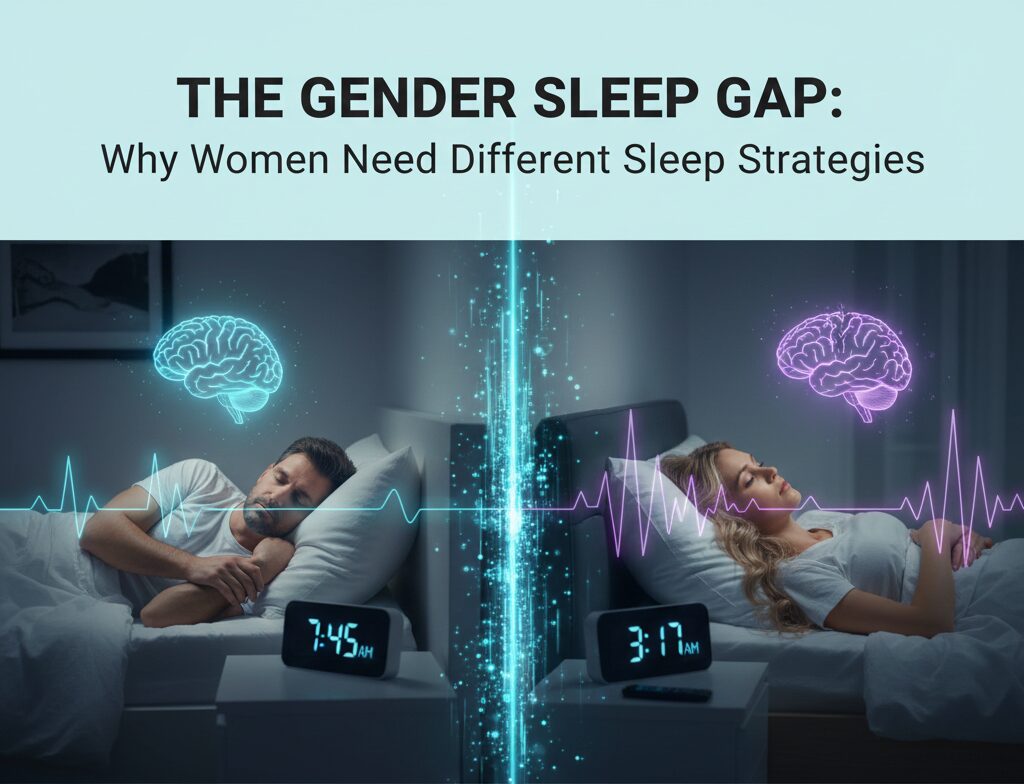
“Dr. Lycan, why am I suddenly waking up at 3 AM?”

I hear this question constantly. And often, the answer isn’t stress or caffeine—it’s biology. In my years of consulting, one truth has become undeniable: sleep guidelines are often written for the “average male,” ignoring the complex hormonal reality of half the population.

We call this The Gender Sleep Gap.

Women report insomnia at rates significantly higher than men, and it’s not because they worry more. It’s because their physiological baseline for sleep is a moving target, shifting not just over a lifetime, but often over a single month.

The Three Biological Disrupters

If you feel like your sleep quality is a rollercoaster, you aren’t imagining it. Clinical data highlights three distinct phases where the “standard rules” fail women.

1. The Cycle Shift (The “Progesterone Drop”)

Many of my clients report 2–3 days of fragmented sleep every month. Science backs this up. Progesterone is a natural sedative; when it plummets just before menstruation, your body loses that calming influence. Some women experience “hypersomnia” (excessive sleepiness), while others face stark insomnia.
  • The Symptom: You feel exhausted but “wired,” unable to settle despite fatigue.
  • The Fix: This is not the time to push through. I advise clients to treat these days as “recovery days”—lighter workouts, earlier bedtimes, and zero caffeine after noon.

2. The Pregnancy Paradox

During pregnancy, the prevalence of insomnia ranges from 15% to 80%. In the first trimester, progesterone spikes, causing daytime fatigue. By the third trimester, the challenge becomes purely mechanical—finding a position that supports the body without compressing the diaphragm.
  • The Symptom: Frequent waking due to discomfort, restless legs (RLS), or shortness of breath.
  • The Fix: Slumbelry Ergonomic Support isn’t just a luxury here; it’s a medical necessity. Proper alignment of the hips and spine reduces the mechanical load, allowing the nervous system to downregulate.

3. The Menopause Thermal Spike

Hot flushes are the single biggest destroyer of sleep for women in midlife. You might fall asleep fine, only to be jolted awake at 2 AM, drenched in sweat. This isn’t a bad dream; it’s a thermoregulatory failure.
  • The Symptom: Nocturnal awakenings followed by an inability to cool down.
  • The Fix: Temperature control is non-negotiable. I prescribe Slumbelry Light Management tools not just for darkness, but to create a sensory-deprived, cool environment that helps mitigate these thermal spikes.

The “Good Sleep” Protocol for Women

We cannot change biology, but we can engineer the environment to support it. Here is the protocol I use with my female clients:

1. Track Your Cycle: Know when your “insomnia window” is coming. Don’t schedule high-stress meetings for those 3 days if you can avoid it. 2. Thermal Regulation First: For menopausal clients, the bedroom must be a refrigerator—18°C (65°F) or lower. Breathable fabrics are essential. 3. Ergonomic Calibration: Your body shape changes. Your mattress support shouldn’t be static. Use supportive pillows to offload pressure from the hips and lower back.

The Verdict

Stop comparing your sleep to your partner’s. His hormones are likely a flat line; yours are a symphony. The goal isn’t to force your body into a standard mold, but to give it the specific support it needs during each phase. Listen to the signal, not the noise.

The Slumbelry Commitment

Sleep is the most vulnerable state of human existence. It is where we heal, reset, and grow.

At Slumbelry, we don’t just sell sleep products; we advocate for your physiological right to rest. From ergonomic support to light management, every solution we offer is designed with one obsession: Respecting your Biology.

Science is our language, but your recovery is our purpose. You take care of everything else in your life—let us take care of your nights.

Rest Deeply,
The Slumbelry Team
The “First Night Effect”: Why Luxury Hotels Ruin Your Sleep

Article Image

Written by Dr. Lycan Dizon, Slumbelry Chief Sleep Consultant

You check into a 5-star hotel. The thread count is 800. The mattress costs more than your car. You lay down, exhausted from travel… and you stare at the ceiling for 4 hours.

Sound familiar?

You aren’t crazy, and you aren’t an insomniac. You are suffering from a documented evolutionary phenomenon known as the “First Night Effect” (FNE).

Your Brain is a Sentinel

When you sleep in a new environment, your brain doesn’t fully switch off. Hemispheric Asymmetry: Research shows that in a new place, one hemisphere of your brain stays more awake than the other*. * The Watchman: It’s a survival mechanism. 10,000 years ago, sleeping in a new cave meant potential predators. Your brain is keeping “one eye open” (metaphorically) to listen for danger.

As How To Sleep Well notes: “To me the most important part of a hotel is the ability to get a good night’s sleep… You would therefore think that hotels would make sleep a priority.”

Sadly, most don’t. They focus on the look of the room, not the neuroscience of the room.

The Hotel Saboteurs

Beyond your own brain, the hotel environment is often designed to destroy sleep: 1. “Junk Light”: Blinking smoke detectors, bright standby lights on TVs, and curtains that don’t quite close. 2. Thermostat Wars: “Too hot because the heating is on constantly, or too cold because the hotel doesn’t heat the room prior to your arrival.” 3. Noise Pollution: Thin walls and hallway chatter.

How to Hack the First Night Effect

You can’t rewire 10,000 years of evolution, but you can trick your brain into feeling safe.

1. The “Olfactory Anchor”

Smell is the strongest trigger for memory and safety. Bring a small vial of your home pillow spray or simply your own unwashed pillowcase. The scent of “home” tells your amygdala: Safe Zone.

2. Bring Your Own Pillow (BYOP)

This is non-negotiable for my clients. Hotel pillows are either “rocks” or “marshmallows.” The Hack: Pack your Slumbelry Ergonomic Support. It’s not just about neck support (though that’s crucial); it’s about tactile familiarity. When your cheek touches your* pillow, your brain registers “Home” and allows the vigilant hemisphere to power down.

3. Sanitise the Light

Hotels are full of blue and green LED spies. * The Hack: Use a clip or tape to cover the TV standby light. Wear your Slumbelry Light Management glasses for an hour before bed to signal to your brain that it’s night-time, regardless of the unfamiliar lighting in the room.

4. The “Safety Walk”

When you arrive, do a full lap of the room. Check the closet, the bathroom, under the bed. It sounds primal because it is. You are consciously showing your brain: “Look, no tigers here.”

The Slumbelry Commitment

Sleep is the most vulnerable state of human existence. It is where we heal, reset, and grow.

At Slumbelry, we don’t just sell sleep products; we advocate for your physiological right to rest. From ergonomic support to light management, every solution we offer is designed with one obsession: Respecting your Biology.

Science is our language, but your recovery is our purpose. You take care of everything else in your life—let us take care of your nights.

Rest Deeply,
The Slumbelry Team
Better sleep tips & exclusive offers, straight to your inbox.

Curated sleep insights, early access to new products, and members-only deals.
No spam. You can unsubscribe anytime.