
How to Fix Sleep Schedule: The Circadian Rhythm Reset
How to Fix Sleep Schedule: The Circadian Rhythm Reset
If you feel “tired all day and awake all night,” your internal clock isn’t broken—it is just set to the wrong time zone. You might be living in New York, but your body is biologically running on Tokyo time. Many people try to force sleep by lying in bed for hours, but this never works. If you want to know how to fix sleep schedule issues permanently, you have to stop focusing on the night and start controlling the day. By manipulating your circadian rhythm through strategic light exposure, meal timing, and movement, you can naturally compel your body to crave sleep at the right time.
- The Master Clock: Your brain’s Suprachiasmatic Nucleus (SCN) controls when you feel tired and alert. You can “program” this clock using specific environmental cues called Zeitgebers.
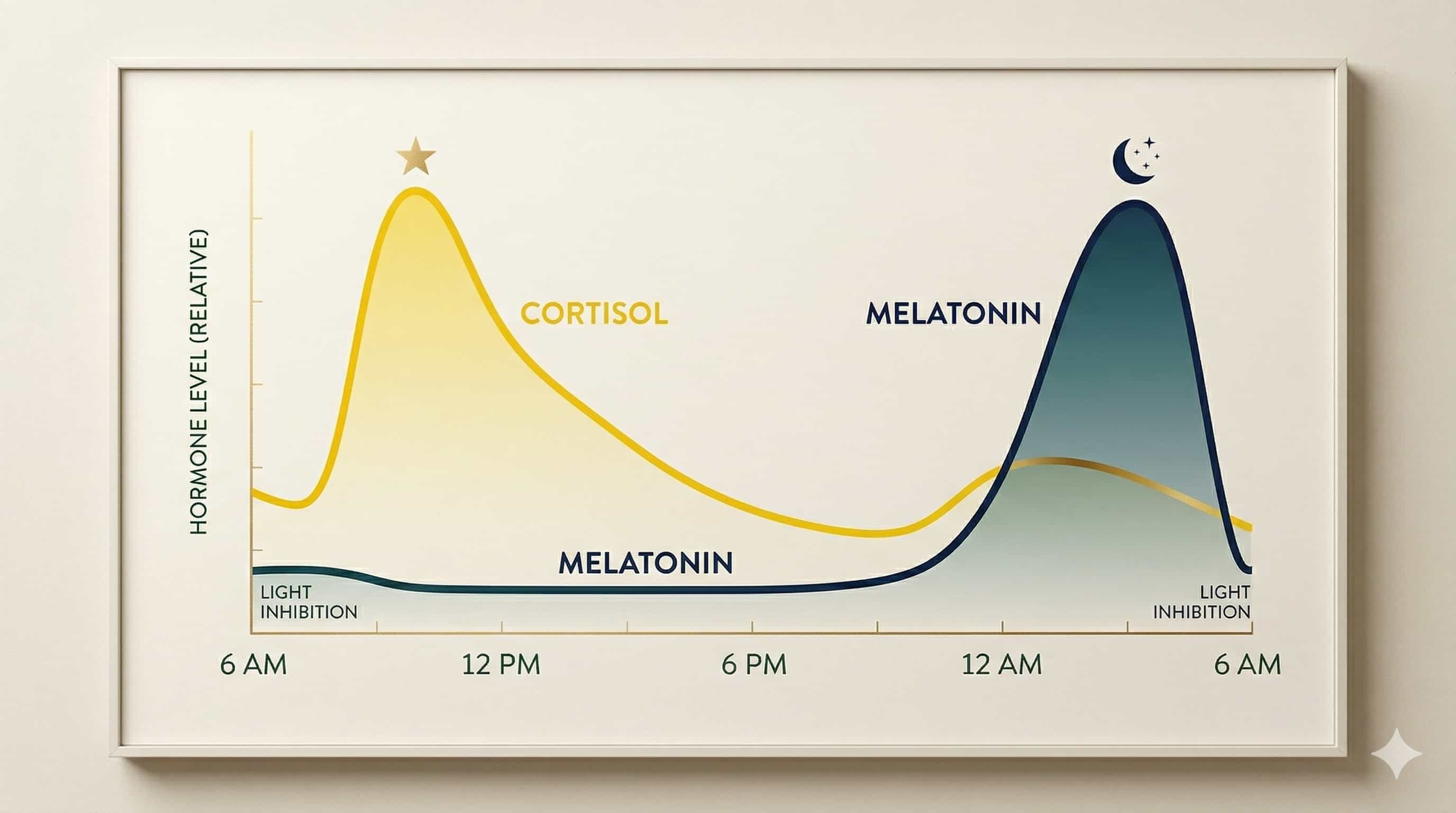
- Light is the Switch: Morning sunlight halts melatonin production and starts a 16-hour countdown to sleep. Evening blue light delays this countdown.
- The Gut Clock: Eating late at night signals to your body that the day is just beginning. Stop eating 3 hours before bed.
- Body Temperature: Exercise raises your core temperature, signaling alertness. Keep late-night movement gentle to allow your body to cool down for sleep.

1) The Science Behind It: Meet Your SCN
Before diving into the protocols, you must understand what is actually happening inside your brain. Deep within your hypothalamus lies a tiny cluster of roughly 20,000 neurons called the Suprachiasmatic Nucleus (SCN). This is your biological master clock.
The SCN orchestrates almost every physiological function in your body. It dictates your hormone release, digestion, body temperature fluctuations, and cognitive focus. It operates on a cycle that is roughly 24 hours long—your circadian rhythm (from the Latin circa diem, meaning “about a day”).
When you suffer from a delayed sleep phase (you can’t fall asleep until 3 AM and can’t wake up until 11 AM), your SCN is misaligned with your physical environment. To shift the SCN, we use external environmental cues called Zeitgebers (German for “Time Givers”). The three most powerful Zeitgebers are Light, Food, and Movement.
2) Actionable Protocol #1: Light (The Master Switch)
Light is the absolute most powerful Zeitgeber. Your eyes contain specialized cells (melanopsin-containing retinal ganglion cells) that connect directly to the SCN. Light is the signal that tells the SCN: “It is daytime, suppress melatonin!”
The Morning Light Anchor:
- Timing: You must get bright light into your eyes within 30 to 60 minutes of waking up.
- Intensity: Outdoor sunlight is best (typically 10,000 to 100,000 lux). Even on a cloudy day, the outdoors is vastly brighter than indoor lighting. Spend 10-15 minutes outside.
- The Effect: This early light exposure triggers a healthy spike in cortisol (waking you up) and sets a biological timer. Roughly 14 to 16 hours after this light exposure, your brain will naturally release melatonin, making you sleepy.
Conversely, evening light destroys your sleep drive. After sunset, blue light from phones, tablets, and LED bulbs tricks the SCN into thinking the sun is still up. This drastically delays the release of melatonin. You must dim your household lights and switch to warm, amber tones at least 2 hours before your target bedtime.
3) Actionable Protocol #2: Food (The Gut Clock)
While the SCN is the master clock in the brain, your peripheral organs (like your liver and gut) have their own independent clocks. These clocks are synchronized by food intake.
Digestion is a highly active, metabolic process. If you eat a heavy meal at 11:00 PM, you are sending a massive signal to your metabolism: “Start working! It’s the beginning of the day!” This creates biological confusion. Your brain is trying to sleep, but your gut is running a marathon.
The Fasting Protocol: Stop consuming all calories at least 3 hours before your intended bedtime. If you are actively trying to shift your wake-up time earlier, eat your breakfast immediately after waking up. Your body will quickly learn to wake up in anticipation of the food. This is one of the fastest biological hacks to cure jet lag or social jet lag.
4) Actionable Protocol #3: Movement (The Temperature Dial)
Your core body temperature naturally fluctuates throughout the day. It is lowest around 4:00 AM and peaks in the late afternoon. Crucially, to initiate deep sleep, your core body temperature must drop by about 2 to 3 degrees Fahrenheit.
Exercise is a powerful thermogenic event—it raises your core temperature significantly. Therefore, the timing of your movement acts as a strong Zeitgeber.
- Morning/Afternoon Training: Engaging in moderate to intense exercise (like running or weightlifting) early in the day reinforces the wakefulness signal and solidifies the circadian peak.
- Late Night Training: Doing High-Intensity Interval Training (HIIT) at 9:00 PM will drastically spike your core temperature and adrenaline. It can take your body 2 to 3 hours to cool down enough to permit deep, slow-wave sleep. If you must move at night, stick to gentle, cooling activities like restorative yoga or light stretching.
5) Consistency is the Ultimate Cure
The SCN is a rhythm-seeking machine. The single most destructive thing you can do to your sleep schedule is constantly shifting your wake times. If you wake up at 6:30 AM for work Monday through Friday, but sleep in until 11:00 AM on Saturday and Sunday, you are subjecting your biology to “Social Jet Lag.”
You essentially forced your brain to fly from New York to California on Friday night, and then demanded it fly back on Sunday night. This is why you feel groggy, nauseous, and miserable on Monday morning. To permanently fix your sleep schedule, pick a wake-up time and stick to it—7 days a week, 365 days a year. Your biology will handle the rest.
6) Frequently Asked Questions (FAQ)
Q1: How long does it take to completely reset my sleep schedule?
If you strictly follow the light, food, and movement protocols, your circadian rhythm shifts by roughly one hour per day. So, if you want to shift your schedule backward by 3 hours, expect it to take about 3 to 4 days of rigid consistency.
Q2: Does looking through a window count for morning light exposure?
No, not really. Modern window glass filters out a significant amount of the lux (light intensity) required to trigger the SCN. Going physically outside, even for just 10 minutes without sunglasses, is exponentially more effective than sitting behind a closed window.
Q3: I work the night shift. How do I manage my circadian rhythm?
Shift workers must use “Anchor Sleep” and reverse the light protocols. Wear dark, blue-blocking sunglasses on your commute home in the morning to prevent the sun from suppressing your melatonin. Keep your bedroom pitch black (using blackout curtains) and incredibly cool during your daytime sleep.
Q4: Should I use melatonin supplements to fix my schedule?
Melatonin is a chronobiotic, meaning it shifts the clock rather than acting as a sedative. Taking a very small micro-dose (0.3mg to 0.5mg) about 3 to 4 hours before your target bedtime can help signal the brain to start winding down earlier, but it should be used temporarily alongside morning sunlight.
Q5: What if it’s completely dark outside when I have to wake up?
If you wake up before sunrise, invest in a 10,000-lux Light Therapy Box (SAD lamp). Turn it on and position it at an angle to your face while you eat breakfast or read. It simulates the biological effect of a sunrise.
Q6: Does weekend sleeping-in permanently ruin my schedule?
Yes, sleeping in for more than 1 hour past your normal wake time causes Social Jet Lag. It delays your sleep pressure for Sunday night, virtually guaranteeing Sunday Night Insomnia and a miserable Monday morning. Always wake up at the same time and use a 20-minute afternoon power nap if you need extra recovery on weekends.
Stop fighting your biology. Master your circadian rhythm and reclaim your energy.
Take the Free Sleep Assessment Join the Recovery NewsletterThe Slumbelry Commitment
Sleep is the most vulnerable state of human existence. It is where we heal, reset, and grow.
At Slumbelry, we don’t just sell sleep products; we advocate for your physiological right to rest. From ergonomic support to light management, every solution we offer is designed with one obsession: Respecting your Biology.
Science is our language, but your recovery is our purpose. You take care of everything else in your life—let us take care of your nights.
Rest Deeply,
The Slumbelry Team